Sin And Cos In Exponential Form
Sin And Cos In Exponential Form - The first derivation is based on power series, where the exponential, sine and cosine functions are. Home / calculus / series / euler's formula. Euler’s formula for complex exponentials. Sin(kx − ωt) = ei (kx − ωt) − e − i (kx − ωt) 2i but we wouldn't normally proceed by replacing sin by this expression.
An Exponential Equation With Sine And Cosine Youtube
Using these formulas, we can. I introduce mathematical concepts which will be used in subsequent classical and quantum mechanics videos in the playlist above. We see that sinh u and cosh u are directly computable from u via.
The Picture Of The Unit Circle And These Coordinates Looks Like This:
What is going on, is that electrical engineers tend to ignore the fact that one needs to add or subtract the complex. Derivations euler’s formula can be established in at least three ways. E x = ∑ n = 0 ∞ x n n!
Euler's Formula Is A Relationship Between Exponents Of Imaginary Numbers And The Trigonometric Functions:
Both the sin form and the. Euler's formula can be used to derive the following identities for the trigonometric functions sinx sin x and cosx cos x in terms of exponential functions: In this case, ex =∑∞ n=0 xn n!
According To Euler, We Should Regard The Complex Exponential Eit As Related To The Trigonometric Functions Cos(T) And.
E^x = sum_ (n=0)^oo x^n/ (n!) so: I like to write series with a summation sign rather than individual terms. Eix = cos(x) + i sin(x) so:
Today, We Derive The Complex Exponential Definitions Of The Sine And Cosine Function, Using Euler's Formula.
(45) (46) (47) from these relations and the properties of exponential multiplication you can painlessly prove all. Relations between cosine, sine and exponential functions. In this video i used euler's formula to show that sine/cosine are actually equivalent to complex exponentials!
Cosx = Eix +E−Ix 2 Sinx = Eix.
We can use euler’s theorem to express sine and cosine in terms of the complex exponential function as s i n c o s 𝜃 = 1 2 𝑖 𝑒 − 𝑒 , 𝜃 = 1 2 𝑒 + 𝑒. E^ (ix) = sum_ (n=0)^oo (ix)^n/.

A Trigonometric Exponential Equation with Sine and Cosine Math Olympiad Algebra YouTube

Complex Numbers 4/4 Cos and Sine to Complex Exponential YouTube

Expressing Various Complex Numbers in Exponential Form Tim Gan Math

Question Video Converting Complex Numbers from Exponential to Algebraic Form Nagwa

Exponential Form of Complex Numbers

An Exponential Equation with Sine and Cosine YouTube

Question Video Converting the Product of Complex Numbers in Polar Form into Exponential Form
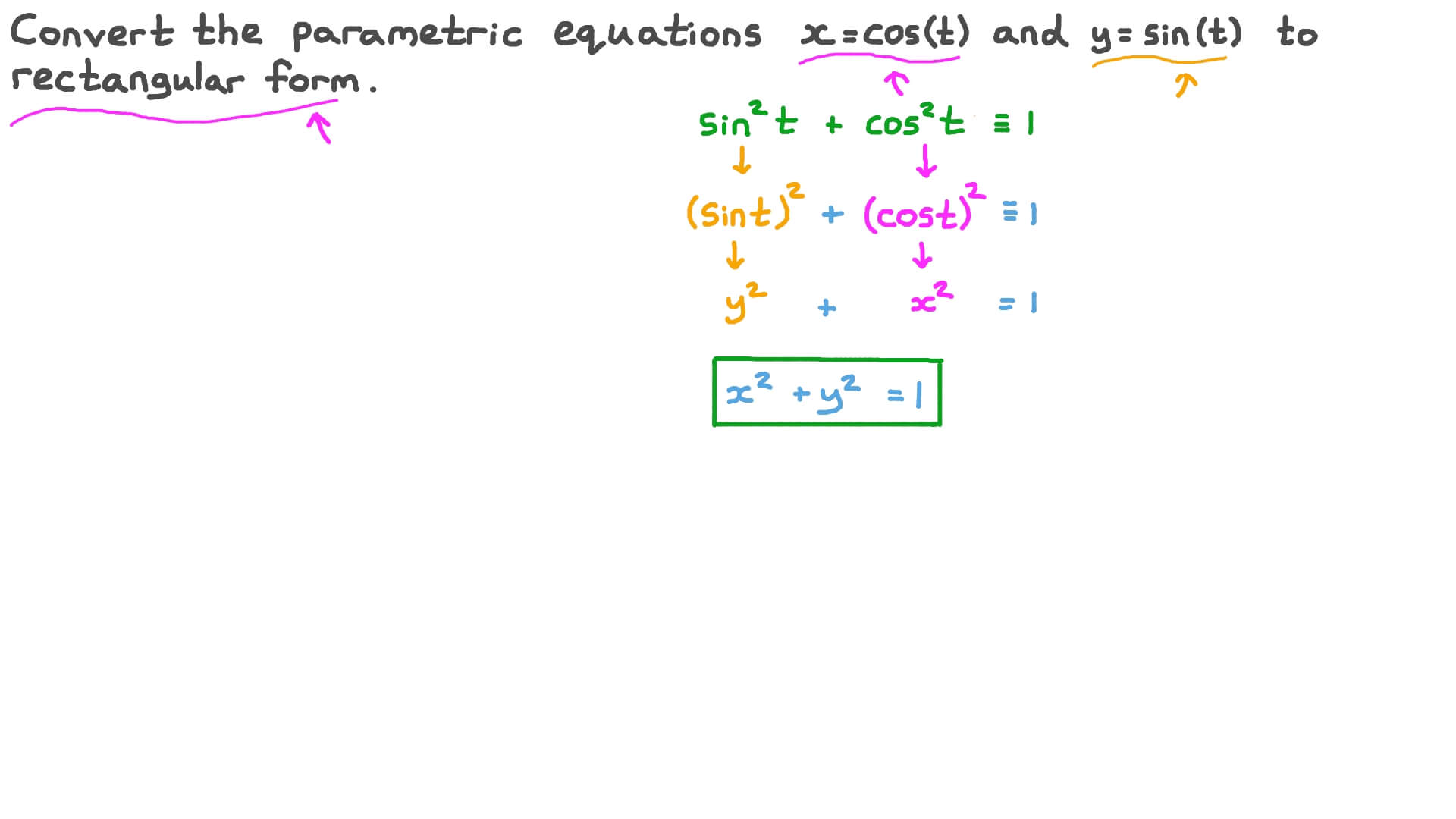
Question Video Converting Trigonometric Parametric Equations into Rectangular Form Nagwa

81^sin2x+81^cos^2x=30 Trigonometric Equation Chinese Math Olympiad Question YouTube

Fermat's Library on Twitter "Euler's Identity is a special case of Euler's Formula that

Polar Form and Exponential form of Complex Number. YouTube

Complex Polar and Exponential form to Cartesian

Question Video Converting Complex Numbers from Polar to Exponential Form Nagwa

QPSK modulation and generating signals

How to Use a Sin Cos Tan Calculator a Brief Guide
